

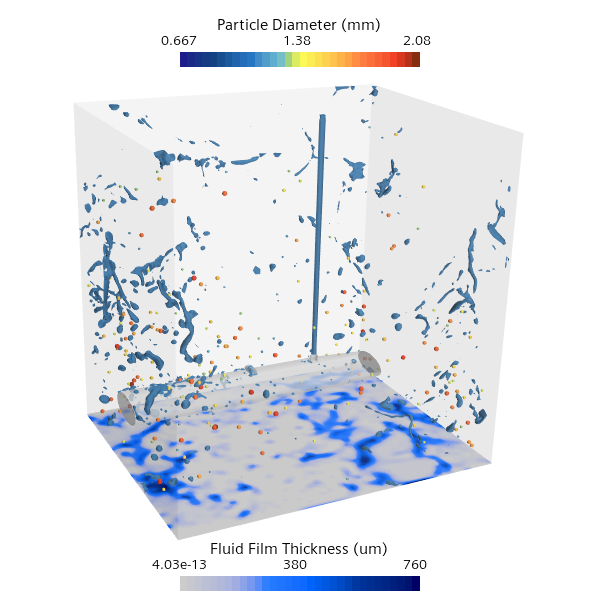
Liquid jets – For Injection, Cooling, Lubrication, Cleaning
ScrollKey facts at a glance
- A water jet exits a round nozzle, hits a box and breaks up into droplets.
- Impact and droplet formation fully resolved numerically.
- Multiphase models VOF and VOF to Lagrange.
- Applications: cooling, cleaning, lubrication and injection.
3D CFD simulation of liquid jets – precise, powerful,and predictable.
They’re used for cooling, cleaning, and lubrication. But for them to work efficiently, they need to hit the right spot — at the right time, with the right velocity, shape, and mass flow rate.
With CFD simulations, we can analyse and optimiset hese jets before a single prototype is built. That means fewer surprises and more control over performance.
The video
In the video below, a water jet exits a supply pipe through a round nozzle, hits a surrounding box, and splashes around. The simulation also captures the breakup of the jet into droplets – fully resolved using advanced multiphase flow modelling (VOF and VOF to Lagrange).
Why CFD simulations?
This level of insight helps engineers make better design decisions early in the development process.
How is a liquid jet calculated?
As long as the jet is coherent, the interface between liquid and air is tracked directly (volume of fluid method). When it breaks up, small droplets are tracked further as individual particles. This combination shows where the jet breaks up, how large the droplets are and where they impact.
How do you proceed?
- Modelling the supply pipe, nozzle and surroundings or target surface.
- Specifying flow rate, pressure and material properties of the liquid.
- Time-dependent multiphase calculation with a fine mesh at the nozzle and in the break-up region.
- Evaluating jet shape, impact location, wetted area and droplet sizes.
- Comparing nozzle shapes, distances or flow rates.
Frequently asked questions
Where is this used?
For cooling components, for cleaning nozzles, for lubrication and in injection systems.
What do I need to provide?
The nozzle geometry, the operating conditions and the properties of the liquid.
Further reading: Two-phase flow · Particle separation in a cyclone
Get in touch with us
Curious how CFD could improve your liquid jet system? Happy to discuss if this is relevant for your application!
--> Predict. Optimize. Perform.
Share Project:
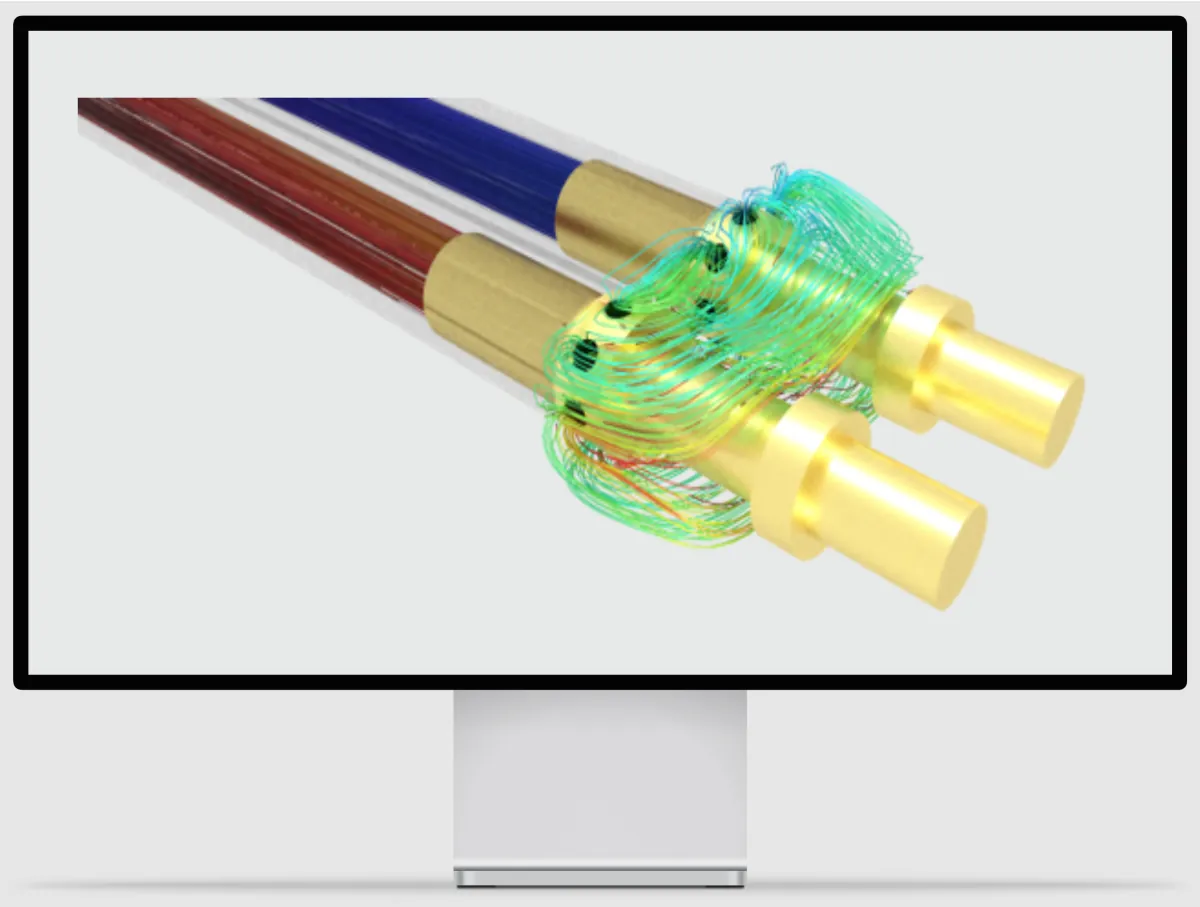
High performance cooling of a charging cable for HPC/MWC application
View Project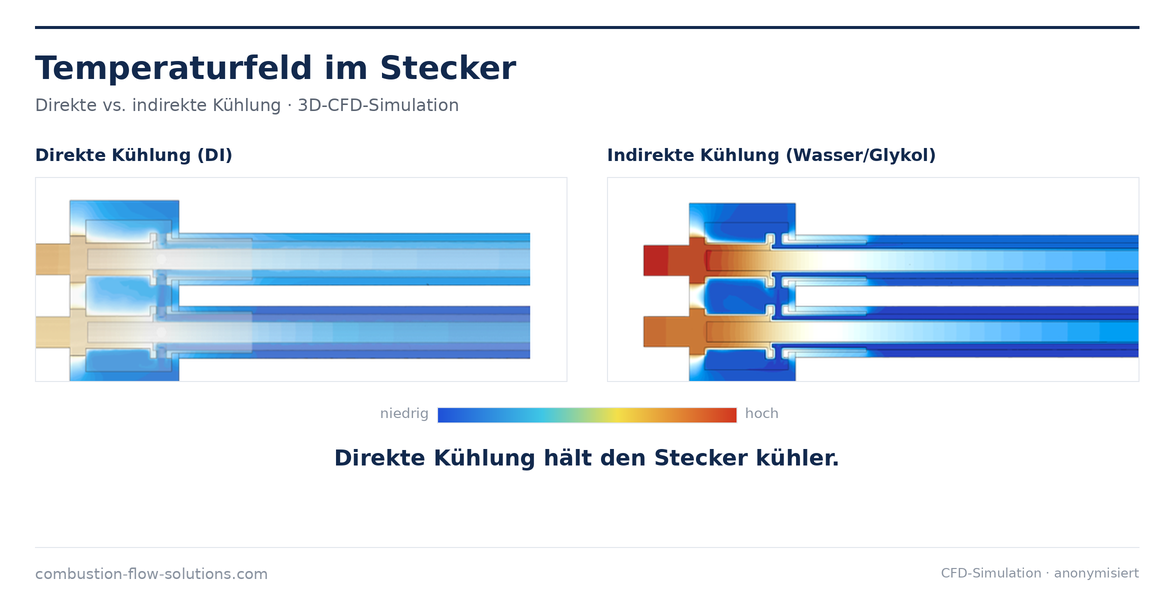
CFD-Simulation für HPC/MWC-Ladekabel: Steckertemperatur um bis zu 35 °C senken
Optimierte Flüssigkeitskühlung senkt die Steckertemperatur um bis zu 35 °C und verlängert die Lebensdauer.
Projekt ansehen